
Writing with Daffodils
A Study in Plant Writing

Daffodil season has passed here in Oregon, but I’m still thinking about them.
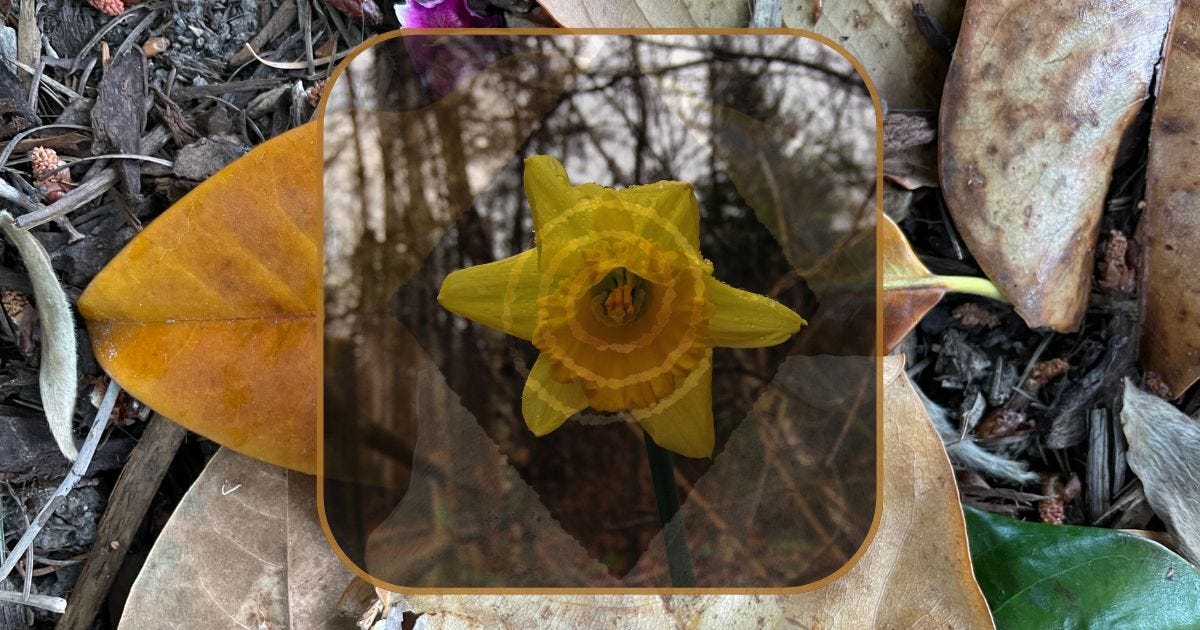
In my new poetry chapbook, The Cemetery Cure, there’s a poem called “A Spell to Bring the Spring.” This is a poem I wrote with the daffodils.
Here’s how the poem came together, including a video about how I write with plants (and you can too)
“A Spell to Bring the Spring” exists in juxtaposition. The daffodils, and the story of their transplanting, inhabit the first and last stanzas while the infusion room, and the people receiving chemotherapy, sit in the middle.
This poem was a later addition to the book, written as I revised and ordered the poems for publication. Much of the chapbook was written while I underwent cancer treatment, though some poems were drafted many years prior to that in the time surrounding my mom’s death. Much of this book was drafted in moments of extremity when linear arcs made no sense. But “A Spell to Bring the Spring” was a poem written in revision. Though I wrote it in my mind many times, I didn’t truly sit down with it until, after treatments for breast cancer, I was returning to the cancer clinic for treatments to prevent recurrence. These returns felt, still feel, unsettling. The cancer gone, so far as we know, I feel too healthy to be there. My mind works differently in that place than it did while I was undergoing chemotherapy. It has a practical sharpness again, an ability to hold, differentiated, the experience of now and the experience of then. My sense of narrative has returned. I am back in the linear flow of time.
I couldn’t have written “A Spell to Bring the Spring” during cancer treatment. My mind did not work that way. It is a memory poem, written in that space while not entirely in that space. It’s a poem written to help readers situate in the collection. I needed a chemo room poem, something to bring readers into that place and its hauntings. But it couldn’t only be a chemo room poem. I needed the daffodils too.
My mom grew daffodils in her garden. They were a favorite of hers and I remember their early spring yellows breaking through the long grey winters of my midwestern youth. The daffodils signaled the spring. First with light leaves reaching tentatively out of the ground, then with their sun-like flowers gazing out at the world.
A couple years ago, in an attempt to rescue unwanted daffodils from a friend who was removing them from their yard, I transplanted the flowers in the midst of their blooming. It wasn’t long after my mastectomy and it felt like violent work, a quick rough job, an emergency evacuation. I replanted them carefully and watched. The next year, sparse leaves emerged after winter but no flowers bloomed. It wasn’t until this spring, just a handful of months ago, that they blossomed, little yellow suns turning skyward.
So, of course, I put all this into a poem.
In this video, I describe an exercise you can use for writing with plants, using my process for writing “A Spell to Bring the Spring” as an example.
If you want to learn more about writing with plants, consider signing up for my online course, Writing with Plants, Animals, and Ecosystems, starting in a few weeks!
Below the paywall is the text of the poem “A Spell to Bring the Spring” and a video of me reading it with the daffodils I wrote it with.
